by Ligia Houben | Jan 31, 2019 | Blog US
You may not choose to suffer,
but you can choose to transform
your suffering into a meaningful life.
Samet M. Kumar
In life we may experience many losses and sometimes it is not easy to confront
what we must live, but we must realize
that our life and the lives of others have significance, and that the meaning of life is the one we give to it.
Therefore, if you are experiencing a loss, being this the death of a loved one, loss of health, loss of a job, divorce – give yourself the value that you deserve and seize the opportunity to grow, in the midst
of this pain, and heal your wounds.
When you do that, you will feel satisfied and you will see life from another
point of view. Do not forget that within
us lies the strength to be able to grow in any transition and find meaning
in how we transform it. This reminds me a story of love and faith, very close to my heart. I want to share it with you.
I met Orali and Moises Flores at the end of 2007. They came to a seminar
I facilitated on grief and loss in Nicaragua, my country
of origin. They had recently
lost their beloved daughter, Albalicia, and were looking for some guidance on how to handle their
grief. That was the beginning of a meaningful relationship. Orali, after learning about the values
of belonging to a support
group as one faces a loss, felt in her heart the desire to organize a self-help
group for grieving
persons and asked me for assistance in how to develop
it. What began as a dream became a reality.
Other bereaved people joined forces and PUDE (Personas Unidas en el Dolor y la Esperanza, people united in grief and hope) was born! This is the ultimate example of the power of transformation. As I stated
before PUDE is very close to my heart because I was there at its origins
and have witnessed the love, purpose and meaning each member hosts
in their heart.
So, each time you may feel without hope as you face an unbearable loss, keep in mind:
- After the darkness comes light
- After the storm, calm
- After the night, the day
- Do not forget that at the end of the tunnel is light. That is the value of hope.
As you transform your loss, you transform your life!
Ligia M. Houben

by Ligia Houben | Jan 16, 2019 | Blog US
Be the change you want to see in the world.
– Mahatma
Gandhi
As we start a new year, many people take the opportunity of planning
the year ahead. They set goals with great expectation and anticipation. Some of them focus
on the physical dimension, starting
a new diet or engaging
in a new plan of exercise. Some want to become better in their jobs or profession, including starting a new career.
Others may want to develop
their spiritual dimension. Setting goals is easy – what about
realizing these goals?
What is your goal for 2019? Are you sure you want to achieve it? Then, the first step is to work in and on yourself. Without changing ourselves, we cannot change our external world. In the seminar I conduct, Live your Life with Meaning and Purpose and Realize your Goals, I ask the participants to do an exercise on discovering what their values are and how to live accordingly.
The following are some of the values
I find essential to live the life you really want to live. These are:
Self-discipline-Perseverance-Faith-Purpose-Passion
Now, let me just briefly
explore each of these
values:
Self-discipline:
if we
want to better ourselves we need to focus on small actions performed every single day that will help us to create a habit.
It has been said it takes 21 days to form a new habit. Do it. Make the commitment with yourself and for 21 develop a habit that will take you closer
to your goal.
Perseverance: Everything takes effort and
planning, especially at times of setbacks, which is when we can learn the best lessons.
In coaching, we never use the word “failure” but feedback,
because one can learn from these experiences. Don’t dismay if you find obstacles, they can only help you grow and become
stronger. Keep focused
on your goal and if you need to change the course of action,
do so, but don’t quit.
Faith: I believe that having faith in you and in a Higher Power,
which for me is God, everything is possible.
Faith is the engine
that keeps us moving
to higher levels of conscience and existence. Sometime ago someone
gave me a card with the phrase
“Let go and let God” and I need to say to you – I cherish those words in my heart anytime
I may feel any doubt or fear.
Purpose: As
we set goals we
need to know the reason behind
that goal. What motivates you? What will this goal bring to your life? As you think in your purpose, use your imagination and visualize what you want to achieve and how do you feel achieving
it.
Passion: The last value you need to have is passion. You must absolutely need to feel in your heart
great excitement as you think
about your goal and have the certainty that you will do it.
If
you follow these values and are willing to work in and on yourself,
you will find yourself engaging in a process
of self-development and growth and with effort and time, you will become the ultimate you!
Remember, your Life has Meaning!
Ligia M. Houben

by Ligia Houben | Jan 8, 2019 | Blog US
There are times in your life when you face a crisis, and you need to decide either to quit or to persist.
How do you know what the best decision is?
When we face a situation that seems too difficult to endure, and you doubt you have the strength to withstand it or that it is not worth the effort, you may quit.
Many times, you don’t even make an effort to make it work; this is quitting. You may stop out of fear, staying in your comfort zone, or lack of self-confidence.
Other times, you do your best for a situation to work, and you put extra energy to see changes. If this doesn’t work, at least you have persisted in the effort and finally realized it is out of your control.
In your life, many things may be out of your control, and you may continue trying to make them work. You can fall into being stubborn. Maybe you do not like to let go.
There is a difference between letting go vs. quitting.
Do not quit before trying, and do not persist if it is not worth it. It’s your life. Make your decisions based on your values and be true to yourself.
Remember…your life has meaning!
Ligia M. Houben

by Ligia Houben | Dec 28, 2018 | Blog US
These are the last days of 2018 and
it is the perfect opportunity to review the year and evaluate our lives. For
this process, I want to offer some resources that may be meaningful to you:
I know this year has been difficult for
many people. Maybe you have experienced a significant loss in your life and
feel a deep pain in your heart. Perhaps you have lost hope in some aspects of
your future and are glad the year is over. Still, you can do something before
the year ends to acknowledge and even honor that loss.
The loss I find most painful and
that touches our hearts very closely is the death of a loved one. If you lost a
loved one and have things you didn’t say…
Did you write that
letter?
What about lighting a
candle next to their picture?
Take the time before the year ends to
honor your loved one doing something he or she would have enjoyed and do it
with all the love in your heart.
What if you lost your
job? This is also a difficult loss because
it can extrapolate to other dimensions, such as our personal relationship or
even our health.
What feelings have you
experienced?
How are you expressing
them?
Have you taken the
time to evaluate all your resources and see if you even want to continue in
that line of work?
If you lost your health,
Have you taken the
time to talk to someone about how you feel?
Are you writing on
your journal?
Do you meditate or
engage in any spiritual ritual?
These are suggestions that could help you process those difficult times you may have experienced in 2018, yet, remember that even in the midst of pain, crisis, or loss you may find things in your life you feel grateful for, such as people who care for you, the skills or strengths you possess that make you special, or the blessing of having food on your plate.
Have you written the
list of things or people to be grateful for?
Lastly….let go of any mistake or
grievance you carry in your heart and…forgive. This means to forgive yourself
or forgive others. You will feel lighter and renewed.
As you take inventory of the year and
clean your soul, you can start 2010 with new expectations and new hopes. You
have your life which is the greatest gift!
I leave you with the inspirational words
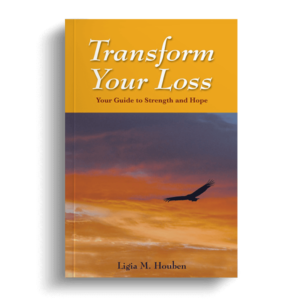
someone said when looking at my book “Transform your Loss” that
embodies my message:
“Despite
darkness…you can still fly”
From the bottom of my heart, I wish you a blessed 2019.
Remember…your life has meaning!
Ligia M. Houben

by Ligia Houben | Nov 15, 2018 | Blog US
People ask me if bereavement support groups help. It is my belief they do if you are open to share and receive. Still, we know not everyone is for support groups. However, if you are, support groups offer you a safe space to open your heart and share your journey with others who have also lost a loved one.
For nine years I had the privileged to train people who were interested in facilitating these types of groups, with Rev. Dr. Dale Young. Dale was the Director of Pastoral Care in Baptist Health South Florida, and this training was offered through their program Congregational Health. When Dale retired, our training stopped. We stayed with the hope to do it again sometime in the future.
I want to thank Morningstar Renewal Center and St. Thomas the Apostle Catholic Church to make this possible.

These past two Saturdays, Dale and I had the blessing of training an amazing group of 23 people. They have the calling of supporting others in times of grief. The training is didactic in nature, with a lot of interaction and role play.

People have the opportunity to ask and share their own history of loss. It is important as we want to help others, to own our grief. Our intention is that people understand the concept of grief and how it can be manifested. The more we know about bereavement, the more we can help ourselves and others.
We finished our training with a beautiful ritual, honoring our loved ones.

This ritual can be done in families, churches and support groups. Rituals in times of loss give a sense of meaning to our grief.
I want to take this opportunity to thank the special people who attended this training, for having so much compassion and love in their hearts.

I also want to thank my husband Mario Houben to take these significative pictures.
Remember…as you transform your loss, you transform your life!
Ligia M. Houben
by Ligia Houben | Oct 22, 2018 | Blog US
You must take personal responsibility. You cannot change the circumstances, the seasons, or the wind, but you can change yourself.
Jim Rohn
Life changes and we change along with it. If you are like me, you may be experiencing changes in life patterns, in life expectations and outcomes. What you envisioned your life to be may not be your reality anymore. What was “known” to you changes, and you may feel baffled, without energy, and hopeless. Are you feeling that way? I understand you; to feel sad and challenged is just human. However….it’s up to you how you continue feeling.
I want to use the analogy of life and the seasons. Many people have written about this analogy, being Jim Rohn one of my favorites. Jim said we all go through Spring, Summer, Fall, and Winter. It is not a surprise! Spring is a time of renewal, new beginnings, new opportunities! We may not even take a pause to think! We enjoy this time in our lives, expecting to last forever. We are hopeful, motivated, and filled with joy!
Then, we reap in Summer what we have sown in Spring. Although, I know that at times what we reap is not a reflection of what we sowed, because there are other variables we may not have taken into account or were out of our control. However, we can still learn from this, change our strategy, and continue renewed with expectations. We still have hope and strength. When Fall comes, is a time to cherish the good times in our lives and prepare ourselves for those times when we will experience the extreme cold of Winter.
Are you facing a Winter now? What kind of Winter is it? What are you doing about it? Are you complaining about how cold it is? Or are you lighting a fire to keep you warm? If you are experiencing an extreme cold Winter, I understand you. Recently, I have experienced a couple of Winters. However…it is up to us, if we freeze to death, or if we choose to wear a warm coat, get close to the bonfire, and know that Spring is about to arrive.
Remember…Your life has meaning!
Ligia M. Houben