

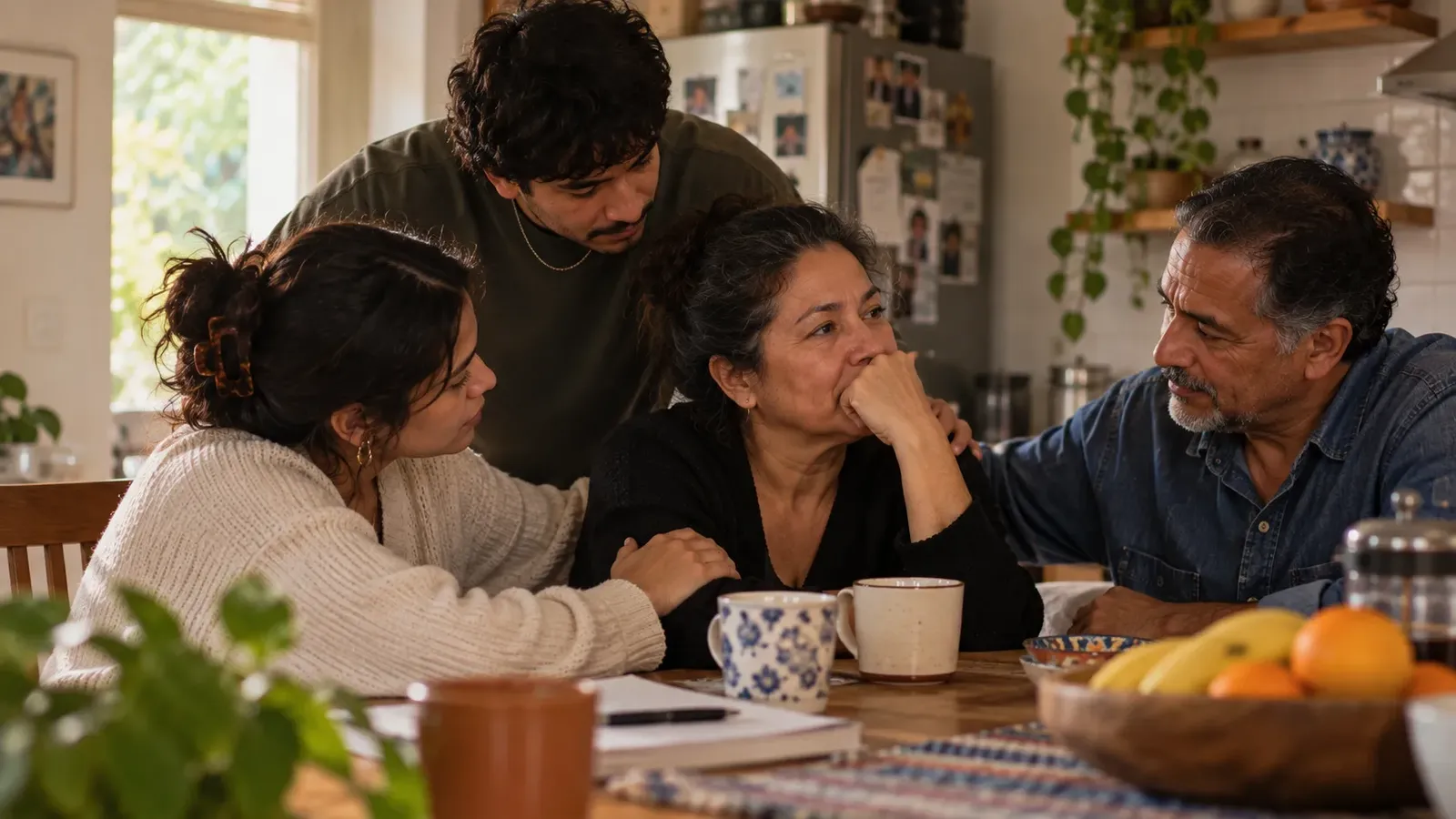
Grief counseling for Hispanic families looks different in every home I sit with. Some families lean on faith and ritual. Others find comfort in staying physically close, cooking together, or simply not being alone. Many blend all of it in their own way. What more than 20 years of this work has taught me is that culture shapes grief, but it never dictates it the same way twice. Through The 11 Principles of Transformation®, I offer a structured, compassionate path that makes room for familismo, respeto, faith, or whatever a family’s own version of healing looks like, without judgment and without asking anyone to grieve on someone else’s timeline.
Why is grief different for Hispanic families?
Grief counseling for Hispanic families starts with understanding that loss rarely stays private. In my practice, grief tends to move through the whole family, carried alongside spiritual beliefs and rituals that shape how mourning unfolds, though exactly how that happens looks different from one household to the next. I’ve worked with families where everyone gathers nightly to pray, and others where one person quietly carries most of the weight. Both are valid.
What role does family play in Hispanic grief?
Family often becomes part of how grief gets processed, not just something people lean on afterward. Decisions about rituals, remembrance, and even how openly to show emotion are frequently made together rather than alone. That doesn’t hold true for every family, but when it does, a counselor who misses it misses something important. I always ask who else is part of this loss, not just who is sitting in front of me.
How do discrimination and isolation complicate Hispanic grief?
Many of the people I work with carry more than loss. Some face discrimination, unfair labels, or the exhaustion of feeling unwelcome in places that should feel safe. Others are grieving without the extended support system they’d have back home. These burdens don’t cancel each other out, they stack. The pain of losing someone arrives on top of the pain of already feeling unseen.
This is why grief support only works when it’s rooted in real cultural understanding, not a generic template applied to everyone. I serve both English and Spanish-speaking clients, with one-on-one sessions, grief resources, and virtual appointments available to families in Miami and beyond. Healing happens in connection, so I try to meet people where their support already lives, whether that’s family, church, or community.
How does familismo shape grief in Hispanic homes?
For families where familismo, the value placed on family unity and loyalty, runs deep, loss rarely stays contained to one person. I’ve seen a child hold back tears so a parent doesn’t carry more weight. I’ve seen a grandmother pour her grief into caring for everyone else instead of naming it out loud. Neither is wrong. It’s one of the ways familismo shows up in mourning, among several.
Why does grief feel different in a collectivist family?
Treating grief as something one person works through alone can miss what’s actually happening in a close family system. When a spouse dies, the person grieving isn’t only mourning her partner. She may also be holding her children’s grief, her parents’ expectations, and the awareness that the wider community is watching how she handles it. In session, I try to make room for that fuller picture instead of narrowing grief down to a single relationship.
How do family roles shift after a loss?
Roles tend to reorganize quickly after a death. An older sibling may step into a caregiving role. A tío or tía may become the one everyone turns to. These shifts aren’t only practical, they’re often a family’s way of closing ranks around the pain. My approach is to work with that reorganization rather than against it, helping each person find room for their own grief even as their role in the family changes. I write more about this in Allow Me to Live My Grief…and Heal from the Inside Out.
What role does faith play in Hispanic grief?
Faith is a cornerstone for many of the families I work with, though not for all of them, and that’s worth saying plainly. For those where it matters, spiritual belief often becomes the frame for understanding death and finding the strength to keep going.
Rituals give structure when life feels shattered. Practices like novenas, rosaries, and regular cemetery visits aren’t just tradition for the families who keep them, they’re lifelines. In my own work, I’ve seen how these rituals create a rhythm of remembrance, a tangible way to express love when words run out.
How do religious communities support grieving Hispanic families?
Where faith communities are part of a family’s life, they often become a primary support system, and that support goes beyond prayer. Church members show up with meals, help with childcare, and sit with the bereaved through the hardest hours. That hands-on care can carry a family through moments when nothing else feels possible.
Why do cultural death rituals matter so much?
Rituals give meaning to loss that can otherwise feel meaningless. A novena creates nine days of shared prayer and presence. A cemetery visit turns an abstract loss into a place you can return to. These practices point to something I remind clients often: grief doesn’t end at the funeral. It honors a relationship that continues even after someone is gone.
Faith gives loss context. Ritual gives grief a shape. Together, for the families who hold them, they create a way forward that honors both the pain and the love that remains.
How can I support a grieving Hispanic family member?
Supporting someone who’s grieving starts with honoring their own way of carrying loss, rather than assuming it should look a certain way. Grief shows up physically, emotionally, spiritually, and socially, often all at once. Acknowledging all of that validates the full experience instead of shrinking grief down to tears alone.
What should I avoid saying to someone who is grieving?
I’d avoid comments that distract from or dismiss the pain. Phrases like “stay strong” or “they’re in a better place,” even when well-meant, can push grief underground. The person hears that their sorrow makes others uncomfortable, and that silence deepens isolation. I try to sit with people in the discomfort instead of rushing to fix it.
How do I validate grief without trying to solve it?
Validation means letting the person lead. I listen without an agenda, reflect back what I hear (“that sounds exhausting”), and ask open questions like “what do you miss most today?” The goal is presence, not problem-solving. Grief doesn’t need a solution. It needs a witness. When someone feels truly heard, they get permission to heal at their own pace.
Cultural values, family closeness, faith, shared rituals, all shape how loss is carried, but they don’t replace the need for someone to simply witness the pain. That’s the space I try to protect. I stay close when things feel unbearable, and I guard against comments that minimize what someone is going through. That steady presence is often what makes room for real change.
Where can Hispanic families find grief counseling?
Families looking for grief counseling that fits their culture usually do best with a bilingual specialist who understands both the language and the dynamics at play. I provide support in English and Spanish, so no one in the family gets left out of the conversation, whether that’s a parent who feels more at home in Spanish or an adult child who processes grief in English.
What makes grief counseling culturally relevant for Hispanic families?
Culture shapes mourning in ways that go beyond language. Many Hispanic families grieve collectively, with extended relatives playing real roles in rituals and emotional processing, though the specifics vary by family and by faith. I build sessions around whatever that relational context actually looks like for the people in front of me, rather than assuming one model fits everyone.
How does a structured program help families move through grief?
Structure helps when loss has knocked everything else out of place. The 11 Principles of Transformation® is a self-paced online program I built to support individuals and groups through grief at their own rhythm. Some people move through it quickly. Others need more time, and the program is built to hold both without pressure.
My book, Allow Me to Live My Grief…and Heal from the Inside Out, is available in English and Spanish and gives families a shared language for talking about what they’re going through, something that often opens conversations that otherwise stay buried.
If you’re ready to start, I’d invite you to explore the program above, or reach out directly. You can call me at (305) 299-5370 or email info@ligiahouben.com, and we’ll figure out together whether one-on-one sessions, the program, or both feel right for your family.
Frequently asked questions
Is it normal for family members to grieve in different ways?
Yes. Even within the same family, grief can look completely different from one person to the next: someone who stays busy, someone who needs to talk, someone who turns to prayer. None of those responses means a person is grieving “wrong.” The goal is understanding each other’s pace, not matching it.
Do I need to be religious to benefit from grief counseling?
Not at all. Faith is part of healing for some of the families I work with, but it’s never a requirement. Whether your path includes prayer, ritual, counseling, or simply having someone listen without judgment, the support should fit you, not the other way around.
Conclusion
Grief counseling for Hispanic families isn’t about choosing between professional support and cultural tradition, it’s about bringing them together. Rituals, faith, and family can give grief a shape and a language, and counseling can give it a safe, steady space to be fully felt. One doesn’t replace the other. If your family’s way of grieving includes novenas and shared meals, we build around that. If it includes quiet, one-on-one conversation, we build around that too. Healing doesn’t ask you to choose between them; it asks you to find what actually helps you carry the loss, and I’m here to help you find it.


